Solar panels in Philadelphia, PA: cost and payback (2026)
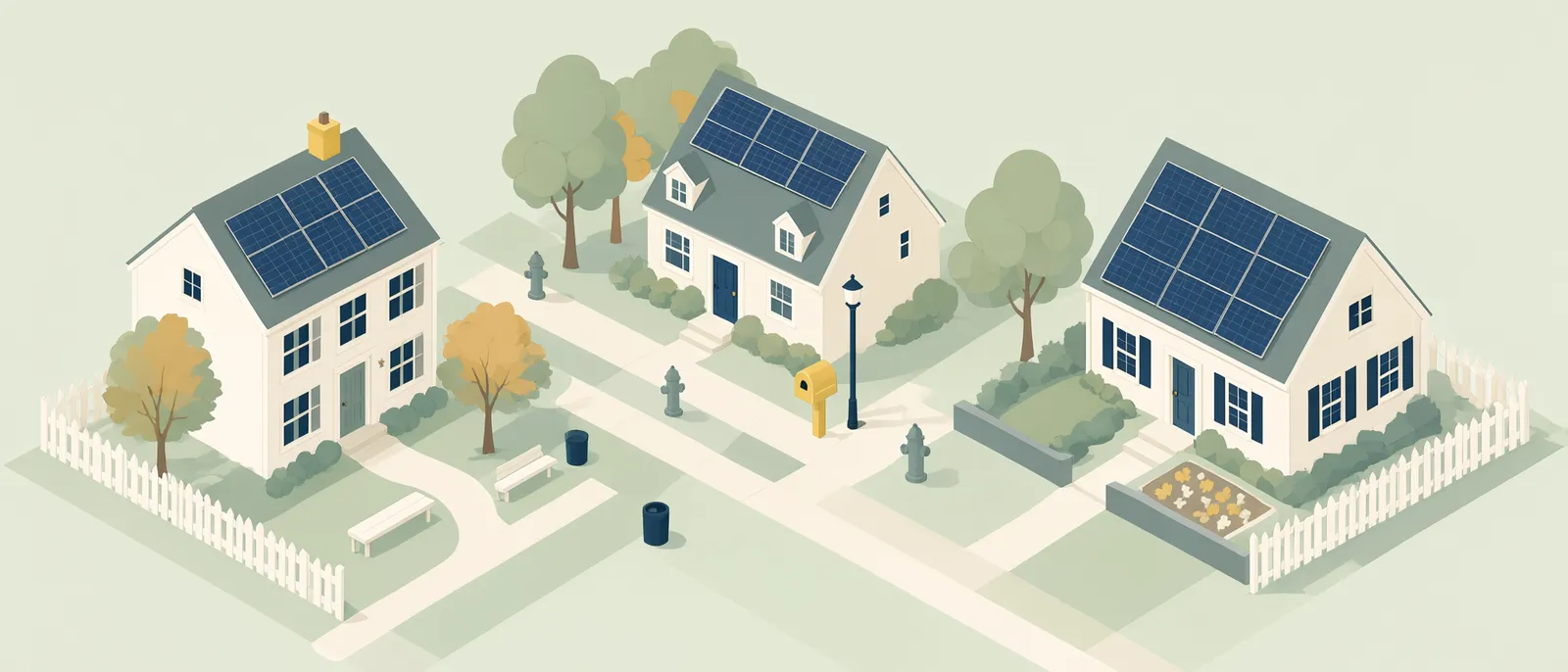
$22,400 installed at the Pennsylvania average of $2.80 per watt.
- Payback
- 12.1 yrs
- Rate held flat
- Monthly offset
- $144
- At 18¢ per kWh
- PECO
- Investor-owned utility
- 4.1 peak sun hours
- Federal credit: $0, ended
Sources: EIA Electric Power Monthly, Table 5.6.A (residential retail rates)NREL PVWatts / NSRDB (peak sun hours and production)DSIRE (state and utility incentives)
Solar panels in Philadelphia cost about $22,400 installed for an 8 kW system, and $20,900 net. There is no federal homeowner credit in that figure — the 30% credit ended for systems placed in service after December 31, 2025. At 18¢ per kWh that system offsets roughly $144 a month and pays itself back in 12.1 years — assuming PECO, which serves most of Philadelphia, credits what you export.
- 8 kW system, installed
- $22,400
- Federal credit (IRC 25D)
- $0 — ended
- Pennsylvania SREC market
- −$1,500
- Net cost
- $20,900
- Serving utility
- PECO
- Monthly bill offset
- $144
- Payback
- 12.1 years
Cost, rate and sun hours are Pennsylvania statewide figures from EIA and NREL — we do not publish a separate Philadelphia rate or sun-hour value we cannot source. The utility is the part that is genuinely local, and it is the part that changes the answer most. Incentives are modelled for today’s date, so nothing expired is counted.
PECO: what it means for solar in Philadelphia
- Serving utility
- PECO
- Ownership
- Investor-owned utility
- Bound by the state net metering rule
- Yes
PECO serves most of Philadelphia. It is investor-owned utility — regulated by the state public utility commission, so the statewide net metering or net billing rule below is the one that applies to you, and any change to it goes through a public docket you can read.
Because PECO answers to the state commission, the Pennsylvania rule is the one that governs your exports: Pennsylvania requires full retail net metering with an annual price-to-compare true-up, one of the cleaner rules in the region.
Whichever it is, this is the first question to settle and the one installers are least specific about. Ask for the rider or tariff name, the per-kWh export credit, how long that credit is locked for, and the current interconnection turnaround — in the written quote, not in conversation. Service territories cut across city limits, so confirm against the name at the top of your own bill.
Cost by system size in Philadelphia
Within one city, quotes still spread. A steep or cut-up roof costs more in labour than a simple south-facing plane. A main service panel at capacity adds a four-figure upgrade before a single module goes up. Two storeys costs more than one. None of that shows up in a per-watt average, which is why the table below is a starting point rather than a quote.
- 6 kW15 panelsGross cost$16,800State incentive−$1,500Net cost$15,300Yr 1 savings$1,293Payback11.8 yrs
- 8 kW20 panelsGross cost$22,400State incentive−$1,500Net cost$20,900Yr 1 savings$1,724Payback12.1 yrs
- 10 kW25 panelsGross cost$28,000State incentive−$1,500Net cost$26,500Yr 1 savings$2,155Payback12.3 yrs
Modelled, not quoted. Production is system size × 4.1 peak sun hours × 365 days × 0.8 for inverter, wiring, soiling and heat losses. Savings value that production at 18¢ per kWh and hold the rate flat for year one. Panel count assumes 400 W modules. Your roof, your shade and your usage move all of it.
No federal credit is in these numbers. The 30% homeowner credit (IRC Sec. 25D) ended for systems placed in service after December 31, 2025. Net cost above is gross cost minus whatever state or local money is still open — nothing else. If a quote knocks 30% off and calls it a federal credit, ask which statute they are citing.
Your roof, not the Philadelphia average.
Five questions about your shade, roof age and actual bill. See the arithmetic for your own address before anyone calls you.
Permits and approvals in Philadelphia
Two approvals, two bodies. The Philadelphia building department issues the electrical and structural permit. PECO issues permission to operate once the work is inspected and, where required, the meter is swapped. Nothing generates a single legal kWh until the second one lands, and the two queues do not move at the same speed.
Permit fees and turnaround vary by jurisdiction and we do not track them, so we are not going to print a number we cannot source. Make the installer put the permit cost and the expected wait for both approvals in the written quote instead of leaving them as a line you discover afterwards.
Incentives and the full state picture: solar panels in Pennsylvania.
Questions from Philadelphia
How much do solar panels cost in Philadelphia?
A 8 kW system in Philadelphia models at $22,400 installed and $20,900 net, at the Pennsylvania average of $2.80 per watt. There is no federal homeowner credit in that — the 30% credit ended for property placed in service after December 31, 2025. Quotes inside one city still vary by several thousand dollars depending on roof pitch, panel choice and whether the main service panel needs upgrading.
Who is the electric utility in Philadelphia?
PECO serves most of Philadelphia. It is investor-owned utility — regulated by the state public utility commission, so the statewide net metering or net billing rule below is the one that applies to you, and any change to it goes through a public docket you can read. That matters more than it sounds: your utility, not your installer and not the state, sets what an exported kWh is worth and how long permission to operate takes. Service territories cut across city limits, so check the name at the top of your own bill.
Do I need PECO's permission to install solar in Philadelphia?
Yes, and it is separate from the building permit. PECO has to approve the interconnection application and then issue permission to operate after inspection. Until that lands, the system does not legally run. The Philadelphia building department handles the electrical and structural permit in parallel. A competent installer files both and can tell you the current turnaround on each without being asked.
Should I add a battery in Philadelphia?
It depends entirely on what PECO pays for exports. Where exports are credited at or near the full retail rate, the grid is already a free battery and a real one rarely pays for itself. Where exports are credited well below retail — which is the direction most tariffs have moved — storing your own afternoon production and using it at night is worth more than selling it. Get the export credit in writing first, then price the battery against it.
Does PECO pay for solar you send back to the grid?
PECO is an investor-owned utility, so the Pennsylvania rule applies to it: Pennsylvania requires full retail net metering with an annual price-to-compare true-up, one of the cleaner rules in the region. Ask for the specific rider name and the credit rate in writing before you sign — it is a tariff, and tariffs get refiled.
Where to look next
See your numbers before anyone asks for yours.
Five questions. Your estimate shows up on screen, not in a sales inbox.