In this guide
Sources: EIA Electric Power Monthly, Table 5.6.A (residential retail rates)NREL PVWatts / NSRDB (peak sun hours and production)DSIRE (state and utility incentives)
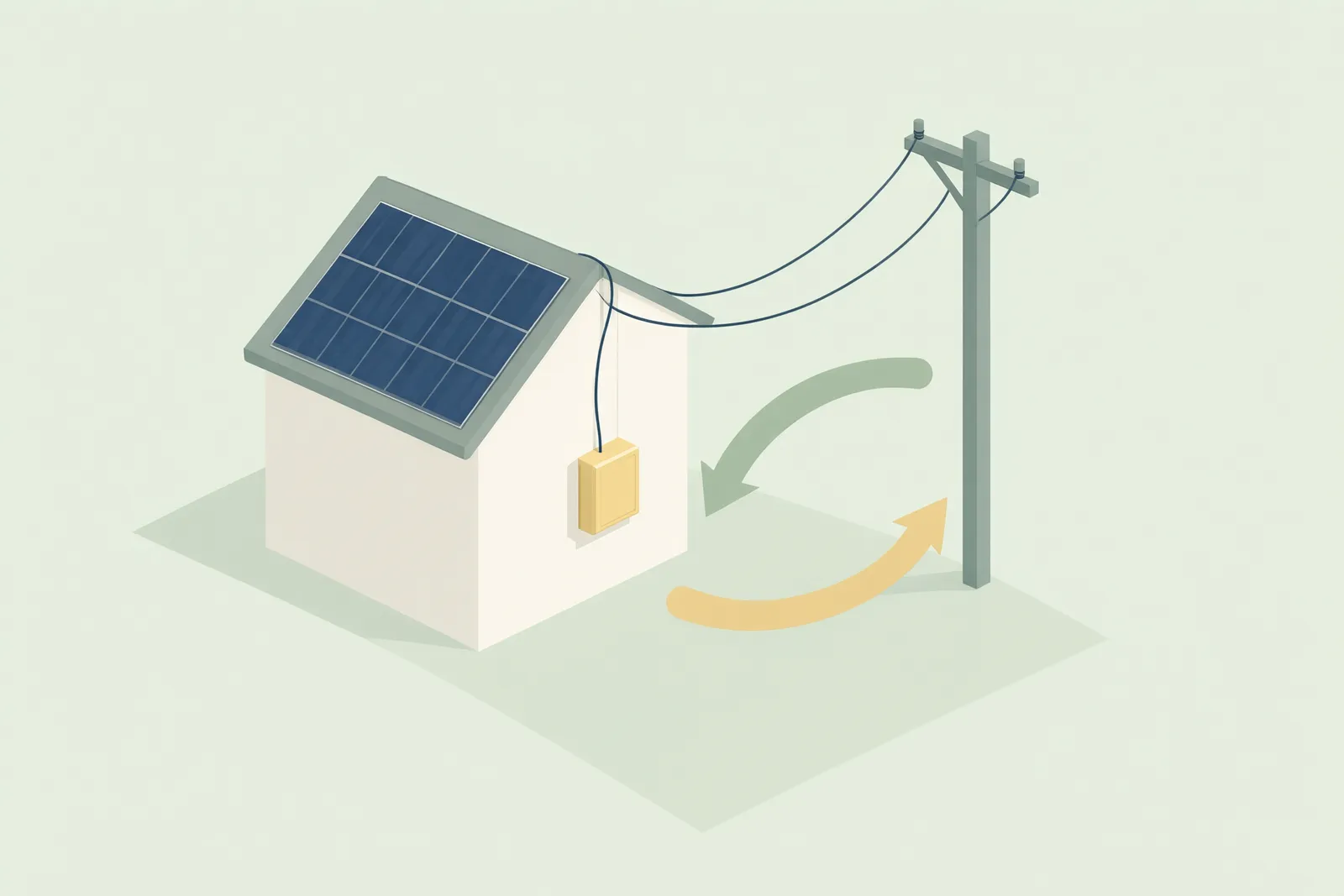
PG&E customers who install solar now are on California’s NEM 3.0 net billing tariff, not net metering: exported power is credited at an export rate far below the retail price PG&E charges to import it, the difference accumulates for twelve months, and it lands in one annual true-up statement.
Export rules are set by state commissions and change through regulatory proceedings. Confirm the tariff your account will sit on, and how long its terms are locked, directly with the utility before you sign anything.
What NEM 3.0 changed
California moved to NEM 3.0 net billing in 2023, which pays roughly 75% less for exported power — solar there now pays best when paired with a battery and heavy self-consumption.
Under the previous arrangement, a California solar owner could treat the grid as storage: export at noon, import at night, settle roughly even in kilowatt-hours. Net billing breaks that symmetry deliberately. Exports are compensated at a rate that reflects what the grid values that power at in that hour, which in the middle of a sunny California afternoon is not very much, while the power you buy back after sunset is charged at a retail rate among the highest in the country.
The result is that the same array on the same roof produces a very different bill depending on when the household uses electricity.
| Behaviour | Under the old net metering | Under NEM 3.0 net billing |
|---|---|---|
| Export at midday, import at night | Roughly a wash | You lose the gap between the two rates |
| Consume your own production | Same value as exporting | Worth considerably more than exporting |
| Oversize the array | Neutral to mildly useful | Poor value — surplus is cheap |
| Add a battery | Backup benefit only | Directly changes the economics |
Why it shows up at the true-up
California solar accounts settle annually. For eleven months you see modest statements and a running balance most people never read, and then the year is reconciled in one bill on your interconnection anniversary.
That is not a trick, and the annual netting genuinely helps by letting a summer surplus cover a winter shortfall. But it does mean a structural gap between import and export pricing compounds for twelve months out of sight. If the running balance on your statements is trending against you in March, you have months to shift load, look at what changed in your usage, and check the array is actually producing what it was modelled to.
The mechanics of that settlement, and how to read it before it arrives, are in the true-up guide.
We will not quote an average PG&E true-up figure. The number depends on system size, household usage, tariff and vintage, and an average across those four is not information about your house. Your own running balance is, and it is on every statement.
Common questions
Does PG&E still have net metering?
Not for new systems in the old sense. California moved to NEM 3.0 net billing in 2023, which credits exported power at a separate rate rather than at the retail rate you pay to import. Systems interconnected under earlier rules were generally grandfathered onto their original terms for a period.
What is NEM 3.0?
It is California's net billing tariff, in force since 2023, which replaced retail-rate export credits with a much lower export compensation rate that varies by hour and season. The practical effect is that power you consume yourself is worth substantially more than power you export, which is what pushed California solar toward batteries.
Why is my PG&E true-up bill so high?
Because under net billing you sell surplus at a low rate and buy back at a high one, and the gap accrues for a full year before it is settled. Add a system sized to older usage, or midday production credited at a low-value hour against evening consumption charged at a high-value one, and a year's worth of that difference arrives as a single statement.
Is solar still worth it for a PG&E customer?
It can be, because California's retail rates are among the highest in the country and every kWh you consume from your own array avoids paying one of them. What has changed is where the value comes from: self-consumption rather than export. That makes usage patterns, load shifting and storage central to the arithmetic in a way they were not under the old rules.
Do I need a battery with NEM 3.0?
Not necessarily, but it changes the maths in a way it did not before. Storing midday production for evening use converts an export credited at a low rate into an import avoided at a high one. Whether that pays depends on the cost of the battery against the size of that gap for your household — which is arithmetic worth doing rather than a rule of thumb worth repeating.