In this guide
Sources: EIA Electric Power Monthly, Table 5.6.A (residential retail rates)NREL PVWatts / NSRDB (peak sun hours and production)DSIRE (state and utility incentives)
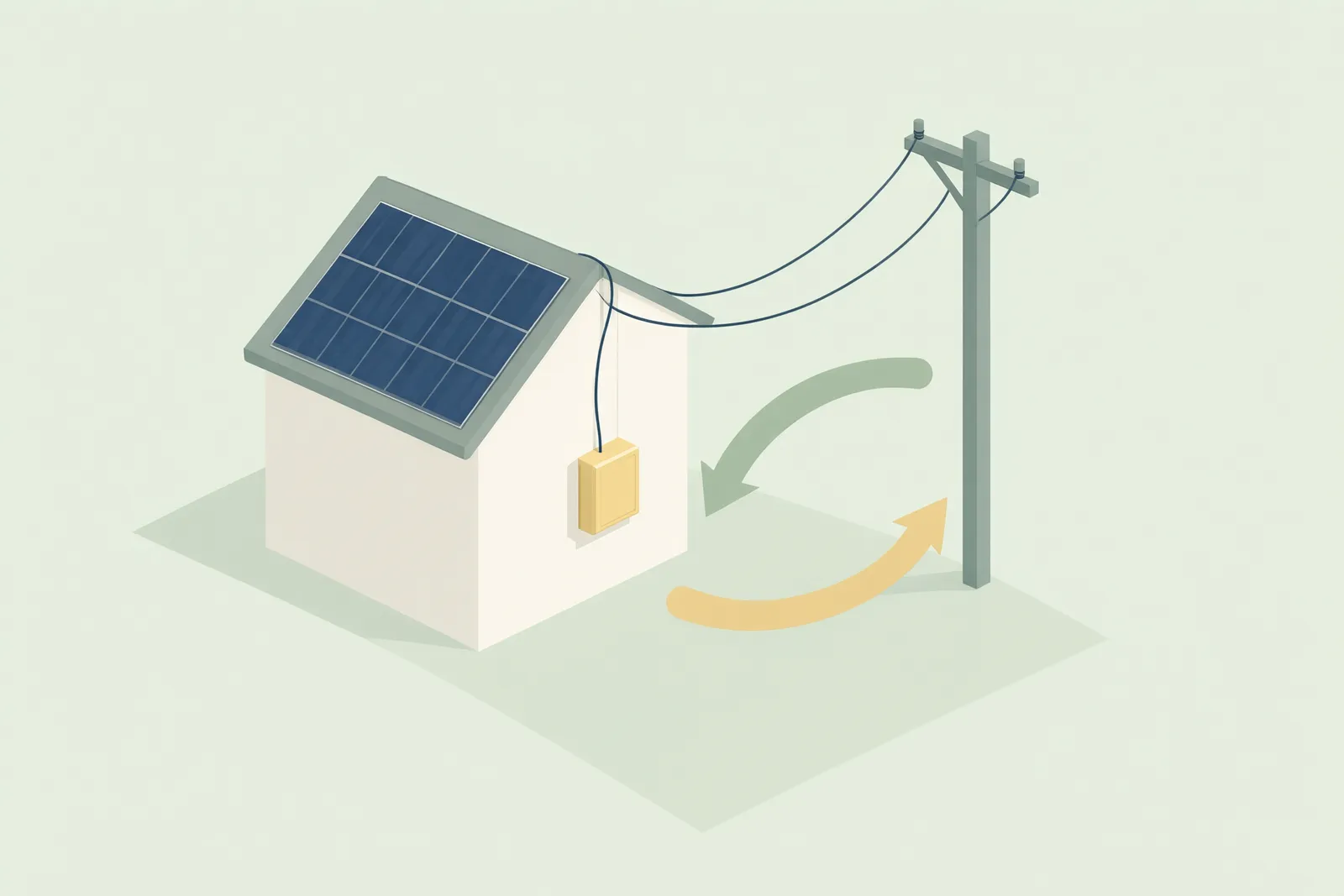
Net metering is a billing rule that credits the solar power your system sends to the grid against the power you take back from it — at full retail net metering, one exported kWh cancels one imported kWh at the same price, though most states have now replaced that with net billing, which buys your exports at a lower separate rate than the one you pay to import.
How the meter arithmetic actually works
Your solar array produces most of its power in the middle of the day. Your house uses most of its power in the morning and the evening. Those two curves do not line up, so at any moment you are either importing from the grid or exporting to it, and a modern meter counts both directions separately.
Everything then turns on one question: what is an exported kWh worth compared to an imported one?
| Arrangement | What an exported kWh is worth | What it means for you |
|---|---|---|
| Full retail net metering | The same as an imported kWh | The grid acts as a free battery across the year. Size to your annual usage; timing barely matters. |
| Net billing / export rate | A separate, lower rate — sometimes varying by hour | Self-consumption is where the value is. Smaller arrays, shifted loads, and batteries start to make sense. |
| Avoided cost only | Roughly what the utility would have paid a generator | Exporting is close to giving power away. Build for what you use, not for what the roof holds. |
| No requirement at all | Whatever your utility chooses to offer, if anything | Ask the utility directly and get the tariff in writing before you size anything. |
The rule is not your installer’s choice. Export terms come from your state commission and your utility. An installer can tell you what the rule is; they cannot give you a better one, and a proposal that models your exports at retail in a net billing state is modelling a rule that does not apply to you.
Why so many states moved off retail net metering
The utility argument is that a retail kWh price pays not only for generating the electricity but for the poles, wires, meters and staff that deliver it. Credit an export at the full retail rate and, they say, a solar customer avoids contributing to that fixed infrastructure while still relying on it — with the shortfall picked up by everyone else.
The counter-argument is that rooftop solar delivers power onto the local distribution network at the moment demand is often highest, which has value the avoided-cost calculation tends to price low, and that the fixed-cost problem is better solved through the fixed charge than by devaluing exports.
Both arguments have been litigated state by state for a decade, and the direction of travel has been consistent: away from one-for-one, toward separate and lower export rates, usually with existing customers grandfathered for a period. Whatever you make of the merits, the practical consequence for a buyer is that the rule you get depends on when you install and which side of a tariff change you land on.
Where the states stand
Three broad camps, with examples. The full description for each state, including which utilities operate there, is on the state page.
Still crediting exports at or near retail
- Florida
Florida still credits exports at the full retail rate for residential systems, though the utilities have repeatedly pushed the legislature to end it.
- Colorado
Colorado still requires full retail net metering at investor-owned utilities, with excess credits rolling forward month to month.
- Delaware
Delaware has full retail net metering with annual true-up, and homeowners can also sell SRECs into the state's compliance market.
- District of Columbia
The District has full retail net metering with no system-size cap for residential customers, and SREC income stacks on top of it.
Replaced with net billing or an export tariff
- California
California moved to NEM 3.0 net billing in 2023, which pays roughly 75% less for exported power — solar there now pays best when paired with a battery and heavy self-consumption.
- Arizona
Arizona ended retail net metering in 2016; exports are bought back under an export rate that is reset annually and sits well below the retail price.
- North Carolina
North Carolina moved Duke Energy customers onto time-of-use net billing in 2023, so export value now depends heavily on when your panels produce.
- Connecticut
Connecticut replaced net metering with the Residential Renewable Energy Solutions tariff, which pays a fixed per-kWh rate for 20 years instead of crediting exports at retail.
- South Carolina
South Carolina replaced legacy net metering with the Solar Choice tariff, which adds time-of-use pricing and a small monthly charge.
- Indiana
Indiana ended net metering for new systems in 2022; exports are now bought at roughly 125% of wholesale, well under the retail rate.
No statewide requirement — it is up to your utility
- Texas
Texas has no statewide net metering rule; in the deregulated market you choose a retail plan with a solar buyback, and the terms vary wildly between providers.
- Tennessee
Tennessee has no net metering law; TVA's Dispersed Power Production program buys exports at a wholesale-linked rate, so self-consumption is the whole game.
- South Dakota
South Dakota has no statewide net metering mandate at all; whether exports are credited is entirely up to each utility.
- Alabama
Alabama has no statewide net metering rule, and Alabama Power charges solar owners a monthly capacity fee while crediting exports below retail.
State rules as reviewed for this site; commissions revisit them constantly and municipal utilities and cooperatives are frequently outside the statewide rule entirely. Confirm with the utility named at the top of your bill before you size a system.
Net metering by utility
The rule that binds you is your utility’s, not your state’s average. These pages cover the utilities we can say something specific about from the state rules we track. If yours is not here, the state page names the major utilities operating in your state and describes the rule they operate under.
What to ask before you sign
Four questions, in writing, from the utility or from the installer with the tariff attached. What is the export credit and how is it calculated? Does it vary by time of day or season? How long are these terms locked for a system energised now, and what happens at the end of that lock? And what happens to surplus credits at the annual settlement — paid, carried, or expired?
That last one leads directly to the annual true-up, which is where a year of monthly credits gets settled into a single bill and where most solar owners discover what their exports were actually worth.
Common questions
What is net metering?
Net metering is a billing arrangement that credits the electricity your solar system sends to the grid against the electricity you take from it. Under full retail net metering the exchange is one for one: a kWh exported at noon cancels a kWh imported at night, at the same price. Your bill is based on the net of the two, plus fixed charges.
What is the difference between net metering and net billing?
Net metering values your exports at the retail rate you pay. Net billing values them at a separate, lower export rate — often tied to what the utility would otherwise have paid for that power, and often varying by time of day. Under net metering the meter effectively runs backwards; under net billing you sell at one price and buy at a higher one.
Is net metering worth it?
Net metering itself is not something you buy — it is the rule you are placed under. Whether it makes solar worth it depends on how close the export credit is to the retail rate. Where exports are credited at retail, sizing to your full annual usage works and payback is at its best. Where exports are credited well below retail, the value of solar comes from what you consume directly, which pushes people toward smaller arrays, load shifting, or a battery.
Does net metering mean my electric bill will be zero?
No. Nearly every utility charges a fixed monthly amount for the connection regardless of usage, and some apply extra charges to customers with their own generation. Full retail net metering can take the energy portion of your bill close to zero across a year; it does not touch the fixed portion.
What happens to my extra solar credits at the end of the year?
That is the annual true-up. Most net metering arrangements roll surplus credits forward month to month and then settle once a year. What happens to a leftover surplus at settlement varies: some utilities pay out at a low avoided-cost rate, some let it expire, some carry it. It is worth knowing which before you size a system to overproduce.
Can my utility change the net metering rules after I install?
Rules change for new customers regularly — that is exactly what has happened across much of the country. Most states grandfather existing systems onto their original terms for a set number of years, and the length of that lock is one of the most valuable things in the whole arrangement. Ask for it in writing before you sign, because it is set by your commission and utility, not by your installer.